Monitoring and tracking3 min read
Light recipes explained: spectrum, PPFD, DLI and photoperiod
A light recipe is the set of light settings a crop grows under: the colour mix (spectrum), the intensity (PPFD), the hours per day (photoperiod), and the total light per day that results (DLI). For lettuce, research and grower guides usually point to a daily light total of roughly 11–17 mol/m²/day; more light grows faster but costs more in electricity and cooling.
What is a light recipe?
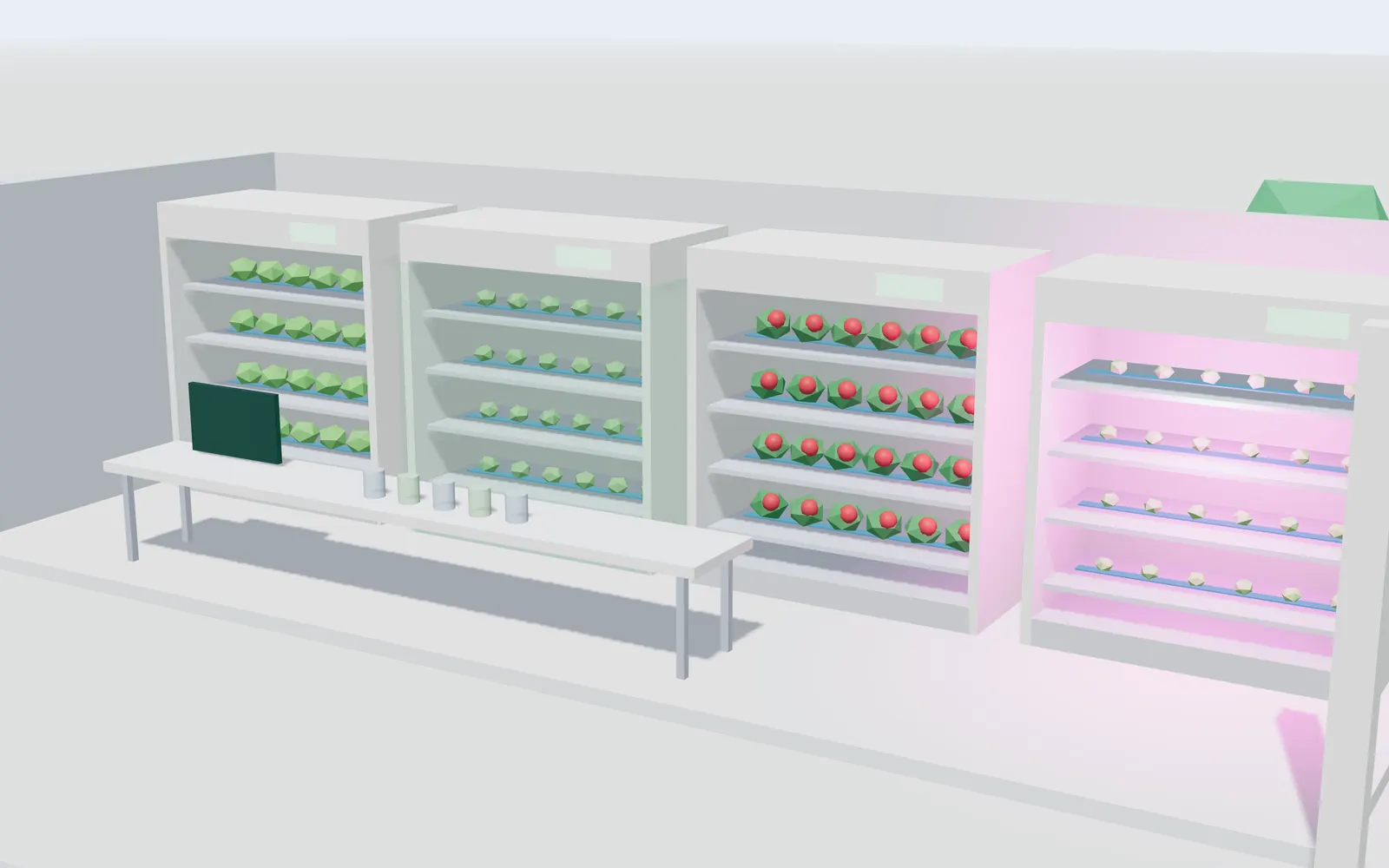
It's the combination of four settings: spectrum (the mix of colours, often red, blue and white), PPFD (how much usable light reaches the plants each second), photoperiod (how many hours a day the lights are on) and the DLI that results (the total usable light per day). Each crop, and often each growth stage, has its own recipe.
How do you calculate DLI?
Multiply the light intensity by the seconds the lights are on, then convert to moles: DLI = PPFD × hours × 3,600 ÷ 1,000,000. For example, 200 µmol/m²/s for 16 hours gives 200 × 16 × 3,600 ÷ 1,000,000 ≈ 11.5 mol/m²/day.
| PPFD (µmol/m²/s) | Hours of light | DLI (mol/m²/day) |
|---|---|---|
| 200 | 12 | 8.6 |
| 200 | 16 | 11.5 |
| 200 | 20 | 14.4 |
| 250 | 16 | 14.4 |
The first three rows are the settings tested in the 2023 iceberg lettuce study listed below.
How much light does lettuce need?
A 2023 study grew iceberg lettuce in an indoor vertical hydroponic system at 200 µmol/m²/s with 12, 16 and 20 hours of light, and recommended a DLI of 11.5 mol/m²/day (16 hours); more light didn't improve the crop's appearance. Grower guides commonly give about 12–17 mol/m²/day for lettuce, and warn that very high daily light can cause tipburn.
Start in that range, then adjust by watching growth, quality and energy together. Other crops, like herbs or fruiting plants, need different recipes.
Does the colour of the light matter?
Yes, but less than the total amount for most leafy greens. Red and blue are used efficiently by plants; white light makes it easier for staff to see the crop's real colour and spot problems. Many farms use a white or red-and-white mix. Changing spectrum can change leaf shape, colour and taste, so test on one floor before changing them all.
How does light affect energy and cooling?
Light is usually the biggest energy use in a vertical farm, and nearly all of it becomes heat that the cooling has to remove. A 2025 study found light intensity was the main driver of total energy use, and its most cost-effective setup used 250 µmol/m²/s. More in how much energy a vertical farm uses per kg.
What should you record for each light recipe?
For each floor or chamber, keep:
- Spectrum, PPFD at canopy level, hours on, and the resulting DLI.
- When the recipe changed, and why.
- Days to harvest, harvest weight and quality for each batch under that recipe.
- Electricity used by the lights, for energy per kg.
How does Lamina help?
Lamina shows each floor's light recipe and its effect on growth speed and energy per kilo, side by side, so you can compare recipes on real batches. Try the light recipes in the live demo, or read the complete guide.
Sources
- Determination of optimal daily light integral (DLI) for indoor cultivation of iceberg lettuce in an indigenous vertical hydroponic system (2023). Scientific Reports
- Longer photoperiods with the same daily light integral increase daily electron transport through photosystem II in lettuce (2020). Plants
- Hort Americas: Daily light integral, are your plants receiving the right amount of light?
- Beyond yield: integrating energy, water, cost, and carbon to benchmark indoor vertical farming viability (2025), arXiv 2507.18419